

Every field has its received wisdom. And if you’re working in a relatively young field, like AI or longevity biotech or robotics, the received wisdom is likely to rest on some shaky foundations: unproven conjectures, partial truths, unchecked biases, assumptions misappropriated from more established fields.
One common failure mode is to take that received wisdom as gospel. Another is to overcorrect by dismissing or devaluing it entirely.
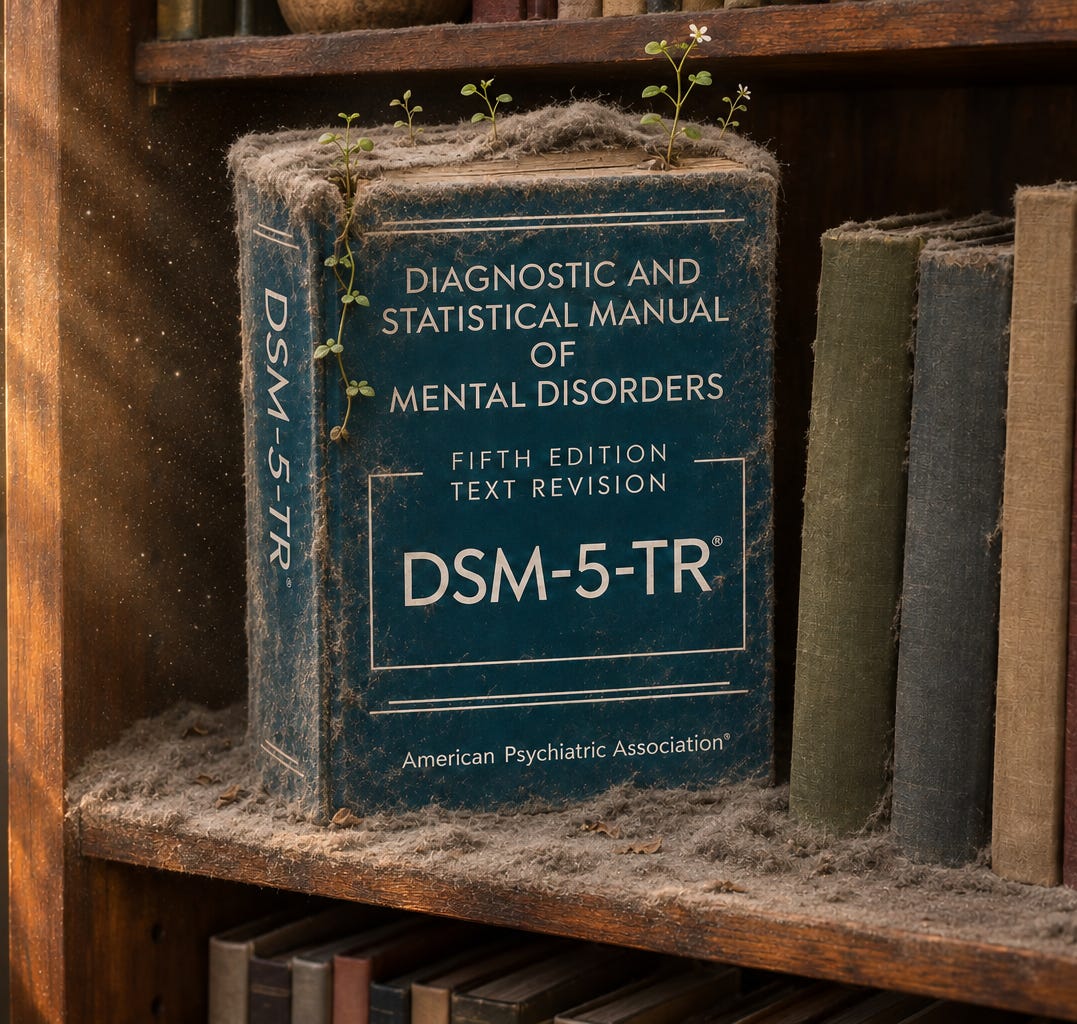
When it comes to my field’s single largest compilation of received wisdom—the Diagnostic and Statistical Manual of Mental Disorders (DSM)—I’m sorry to say I succumbed to the latter.
Most clinical psychologists have a love-hate relationship with the DSM. We bemoan how it lumps people into overly rigid and superficially-defined categories, and yet we routinely rely on those categories for our diagnostic and clinical decisions.
For my part, I pretty quickly came to err on the “hating” side: as a clinical research assistant administering hundreds of structured DSM-based clinical interviews, I saw again and again how two people could be diagnosed with “Major Depressive Disorder” despite having wildly different histories and presentations, whereas two people with similar underlying insecurities would receive different diagnoses based on which side of a weight cutoff they happened to fall on or the date of their latest panic attack.
When I got to graduate school and read some of the scathing critiques of the DSM by leading scholars in the field, my hatred felt even more vindicated. Of course I still memorized the symptom criteria for the most common diagnoses, as we all did; but I rolled my eyes as I did so, treating it as a necessary evil for research standardization and insurance purposes. When absolutely necessary, I consulted the “Diagnostic Criteria” sections of whichever DSM edition we were on (currently the DSM-5-TR) for whatever disorders I needed to rule in or out. (And by “consulted” I of course mean “googled,” since they are all readily available online.)
As to the rest of the 1,152-page manual, I saw no reason to bother with it.
Only as a faculty member tasked with developing my own Psychopathology course for first-year clinical psychology doctoral students did I find the impetus to crack open the actual book, reading beyond the symptom criteria I could so easily rattle off. I expected to flip through a few pages just to confirm how useless they were, thus helping me make the case to students for why they should approach the DSM with the same healthy skepticism that I did.
What I discovered instead was a comprehensive compendium of clinical and scientific knowledge and pattern-matching expertise that could have served me and my patients well throughout my career to date, had I bothered to read it. Some of it was outdated or suspect, and some I’d picked up elsewhere along the way; but a shocking amount was both relevant and new to me.
Each disorder’s entry begins with, yes, the list of generic symptom criteria and semi-arbitrary numeric cutoffs I was used to. But then it launches into a “Diagnostic Features” section, complete with rich qualitative descriptions of common and less common clinical presentations across different circumstances, subtypes, and levels of severity—followed by sections on the disorder’s typical development and course, the factors known to predict or correlate with it, and guidance for differentiating it from look-alike conditions. For Major Depressive Disorder, for example, we learn that psychomotor disturbances (e.g., moving more slowly than usual) are less common than fatigue and sleep disturbance, and are “indicative of greater overall severity.” And we learn what aspects of the patient’s presentation should sensitize us to the possibility of a bipolar versus unipolar depression.
As I sifted through the troves of clinical description, explanation, and background research hidden in this long-neglected tome, a new goal took shape: to equip my students to mine real knowledge from the DSM, as I now wished someone had equipped me to do when I was a first-year doctoral student.
To that end, of course, I needed to know the source material backwards and forwards myself. And so I found my latest pretext to indulge in that singular thrill, that uniquely luminous form of aliveness I’d always cherished and hadn’t often enough made time for: the no-holds-barred expedition down a bottomless intellectual rabbit hole.
I dug up and read the meta-analyses and competing position papers and documented task force discussions (and, in some cases, outright turf wars) on which the latest DSM was basing its classifications and claims, and then the individual studies cited within them.
I traced the diagnostic conventions and terms of art in those studies to their origins in psychoanalytic theory, to the philosophical and professional battles that reshaped psychiatric diagnosis in the 1960s, ’70s, and ’80s, and to the evolving cultural discourse around everything from the scientific standing of psychiatry to the moral standing of homosexuality.
I read passages by early psychoanalysts who described, with fascinating nuance and observational detail, the varying presentations and therapeutic journeys of their “neurotic” versus “psychotic” versus “borderline” patients, as they understood these distinctions at the time.
To be sure, I found no shortage of eyeroll-worthy methods, arguments, and conclusions in the DSM. And yet: the amount of substantive psychological knowledge I gained from those months down the DSM rabbit hole rivaled all my previous graduate coursework combined.
What of the diagnostic criteria themselves? In some cases, I became more convinced of their validity and usefulness after retracing the logic behind them. In other cases, I still doubted or outright disagreed with the DSM-5’s classifications; but even then, I often learned something valuable from the reasoning that led to them. For instance, I still don’t think it makes sense conceptually to separate OCD from the anxiety disorders; but following up the research behind that decision gave me a lot more insight into the unique role of “just right” feelings in OCD, which has allowed me to identify and address these experiences with greater finesse in therapy.
This and other discoveries I made through my DSM deep-dive have made a concrete difference for the patients I’ve since treated or consulted on. I wish I had made them sooner.
I also gained a deeper understanding and appreciation for the problem that those “semi-arbitrary numeric cutoffs” I’d rolled my eyes at were built to solve. Retracing them took me back to the 1960s and ’70s, when psychiatric diagnosis was in open crisis. A landmark US–UK study had shown that American and British psychiatrists, watching the very same recorded interviews, diagnosed schizophrenia at wildly different rates. The diagnosticians disagreed because the field had, and still has, no shared causal understanding of psychopathology. Psychoanalysts saw unconscious conflict, behaviorists saw learning histories, the ascendant biological psychiatrists saw brain disease, and each school’s intuitions about what counted as “depression” or “schizophrenia” differed accordingly. A finding about “anxiety neurosis” from one camp could not be compared with a finding from another, because they were not reliably talking about the same patients.
The DSM-III’s solution, in 1980, was to stop arguing about causes and agree on descriptions. Its criteria were deliberately “atheoretical with regard to etiology”: lists of observable symptoms, with durations and counts, that a psychoanalyst in Boston and a behaviorist in London could apply to the same patient and arrive at the same label. The thresholds were set where they were not because anyone believed nature carves depression at five symptoms and two weeks, but because a shared descriptive vocabulary, however crude, was the precondition for pooling our observations at all. (Arriving at this shared vocabulary was no small feat of communication and diplomacy; the psychoanalytic establishment nearly torpedoed the manual over the removal of the word “neurosis,” which survived in parentheses as a peace offering.)
Every meta-analysis I was now reading, every finding about course and treatment response I’d been mining from the Diagnostic Features sections, existed only because the field had first agreed to speak this lingua franca.
Most young fields have such truces—shared benchmarks, reference architectures, diagnostic checklists—and they are often semi-arbitrary for the same sorts of reasons.
Knowing this didn’t make me love the cutoffs. But it changed what I saw when I looked at them, and what I did with them. The DSM was never meant to tell me what’s wrong with the person in my office; it was built to tell me where the field’s accumulated knowledge about people like her is filed. So I now use it as exactly that: an index into everything we have collectively learned about patients who fit a given description, which I can then bring to bear on the harder work of understanding this particular patient. The critiques I’d absorbed in graduate school began to look different, too. Anyone who wants to replace the DSM has to supply what it lacks—a shared causal understanding—or at minimum provide a better way for our fractious, pre-paradigmatic field to keep talking to itself.
Received wisdom is a gift, if you do the work to unpack it
As an ambitious builder, you may need to challenge or even entirely dismantle the received wisdom within your field in order to make progress. But what my DSM experience taught me is that this makes it more, not less, important to study the received wisdom thoroughly. This is the kind of intellectual ambition that sets the best builders and innovators apart.
Even a shaky foundation gives you some ground to stand on, and if you don’t do the work of understanding how that foundation got built and what problems it is attempting to solve, you can’t expect to get far in building a better one.
If you’re working in AI, for example, this may mean reading and retracing the claims in “Attention Is All You Need” or some of the early scaling-laws papers; if you’re in robotics, it might mean reading Rodney Brooks’s “Elephants Don’t Play Chess” alongside the sense-plan-act tradition it was rebelling against; if you’re in longevity biotech, it might mean reading “The Hallmarks of Aging”—a framework that has since been both expanded to twelve hallmarks and criticized as a list masquerading as a theory—and reverse-engineering its claims to the experiments on which they rest.
You don’t necessarily have to assemble this reading list from scratch: in some fields, knowledgeable practitioners have already curated paths through the foundational literature, like the database researchers behind Readings in Database Systems, who explain not only which papers to read, but why they remain worth reading.
Start with a problem you’re trying to solve.
You don’t have to retrace an entire field before you’re allowed to contribute to it. Start with a specific problem you’re already trying to solve. Which claims are you relying on, what evidence and arguments support them, and where did they come from? If there are competing approaches to this problem within the field, what can you learn by taking the best version of each approach seriously? Follow that trail far enough that you can judge what to build on, what to revise, and what to discard.
Just passively reading all the relevant material is not enough, of course (any more than having AI summarize it for you). To make it your own, you need to process and integrate it through some form of active engagement with the material and with the reality it is (however imperfectly) aiming to describe. As with any building project, you need the right sorts of feedback loops. For me this was working with patients directly; for you it might be running your own experiments, or interning at a lab where you run up against the problems being described in the literature first-hand, or joining a reading group with people who have such direct experience.
If you do this right, you’ll soon find yourself among the very few who actually know what you’re talking about when discussing this problem—including what’s known, what’s contested, and what work remains to be done. And even more importantly, you’ll have experienced first-hand what it’s like to come to know what you’re talking about: an invaluable benchmark and sanity-check for any further expertise you go on to build, in this field or any other.
Thus you’ll have cleared one of the greatest hurdles to building something new and valuable atop whatever foundations you are standing on.
Would love to hear from you, dear readers: what’s your field’s version of the DSM—a foundational text or “received wisdom” that most people either accept or dismiss but don’t read that closely? What’s your relationship to it? Or are there any analogous intellectual deep-diving expeditions you’d like to undertake when you get the chance?
This was a very exciting read. This kind of taking ownership of the raw materials of a complex field creates a space in which great things can happen. The epic scale of this particular rabbit hole was both inspiring and daunting.
I'm not a psychologist but I enjoyed this essay. Thank you.